London · Q2 2026
Bifold vs Sliding Doors
The honest, installer-side truth
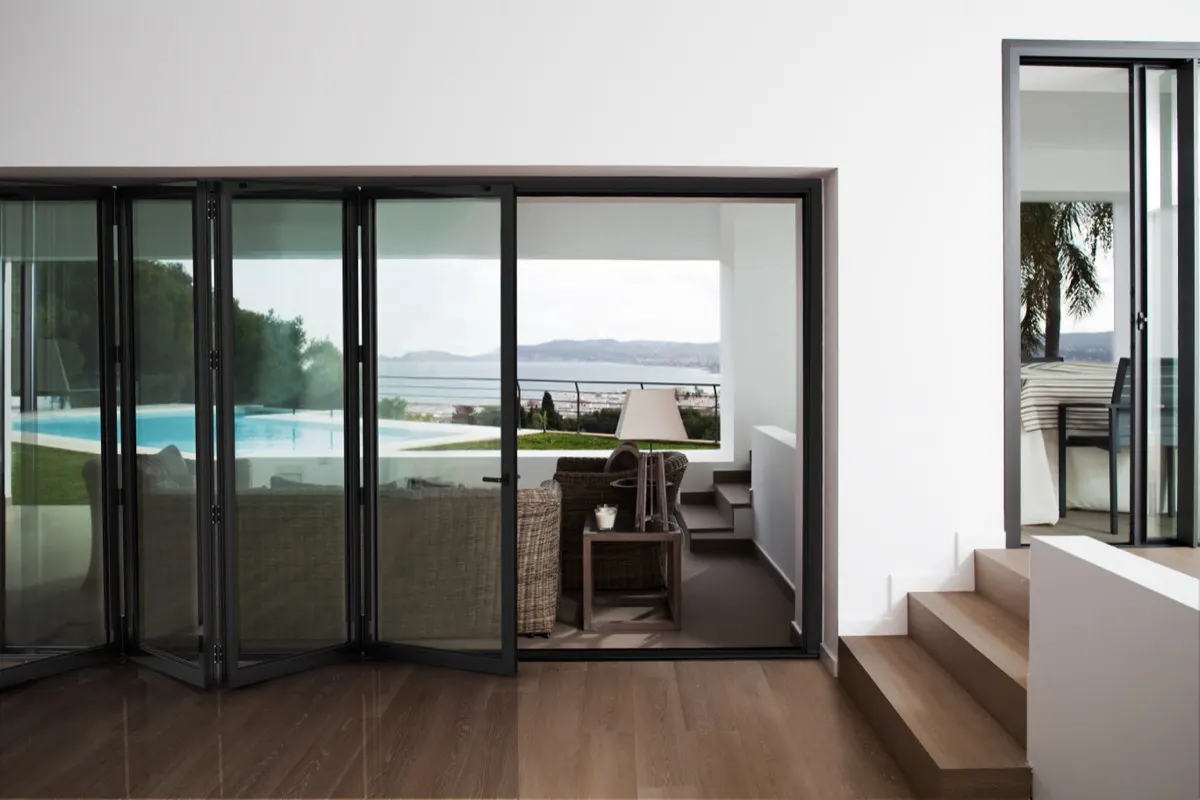
Both products work. Both have a place. The pattern across our London projects is consistent: bifolds win for opening wide and entertaining; sliding wins for the view through the glass. If your door spends most of the year closed, you will notice a bifold's meeting stiles, published at 90 to 122mm depending on system. If it spends the summer open, you will notice that a slider only ever opens part of the span.
Sightline comparison
When the doors are closed, which in London is most of the year, the width of the vertical section where two leaves or panes meet determines what you actually see. Every figure below is the manufacturer's own published dimension.
| System | Type | Published section where leaves meet |
|---|---|---|
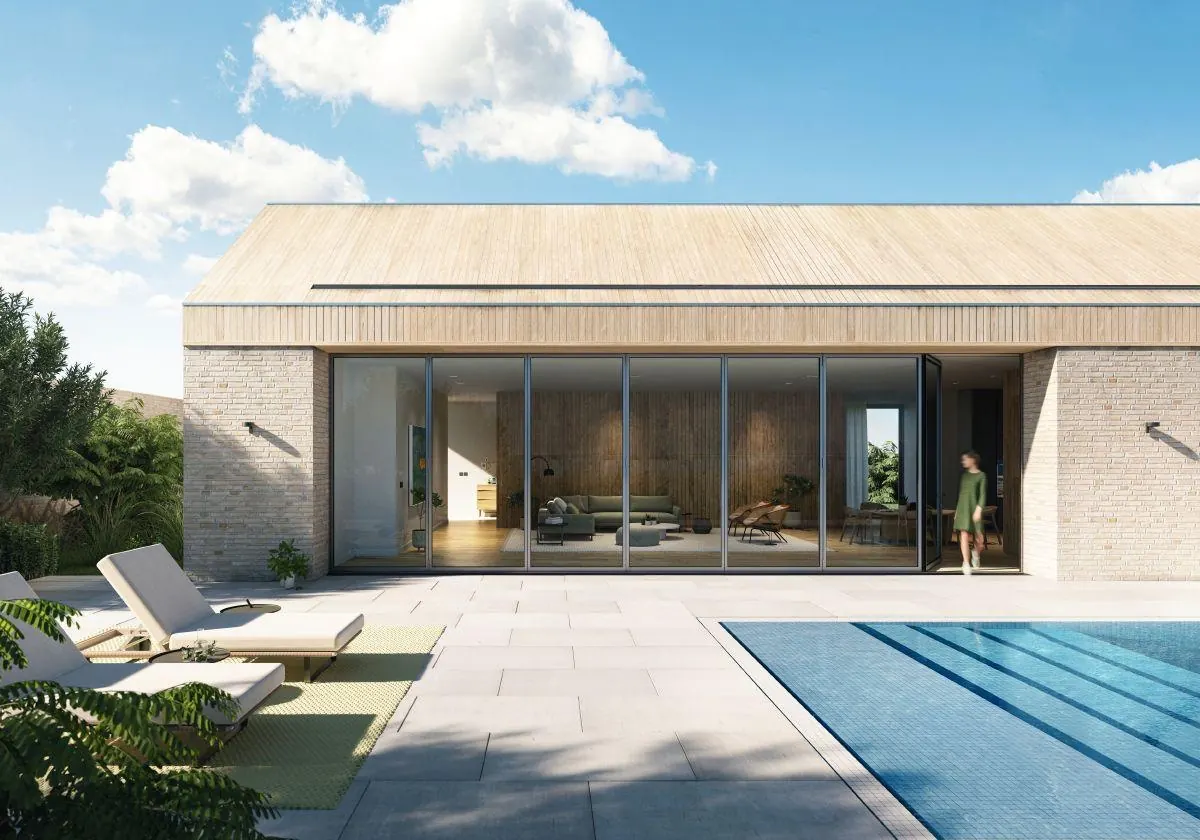
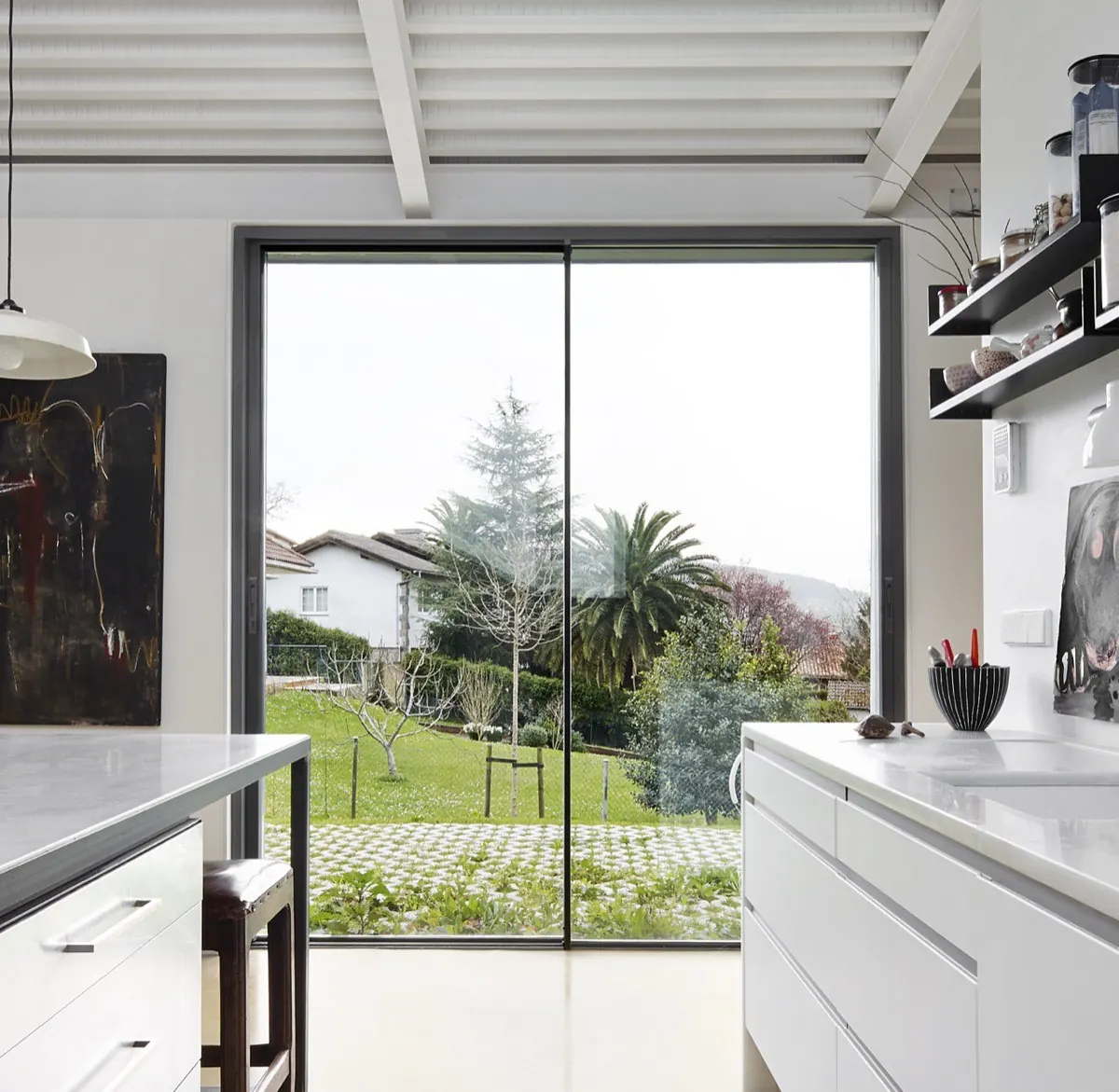
| APX20 Ultra Slim (Cortizo COR Vision Sliding) | Sliding | 20 mm central junction |
| APX20 Plus (Cortizo COR Vision Plus Sliding) | Sliding | 25 mm central junction |
| Schüco ASE 60 / ASE 80.HI | Lift-and-slide | 40 mm Design Line, otherwise 102 mm |
| APX47 (Cortizo 4700 Sliding) | Sliding, large pane | 50 mm sash |
| Schüco AS FD 75 / AS FD 90.HI | Bifold | 90 or 104 mm at the vent joint |
| APX Fold | Bifold | 122 mm typical sightline |
Opening behaviour
Same structural opening, completely different open-state experience. This is where bifolds reclaim ground sliders cannot match. Figures below are the geometry of the configuration, not a manufacturer specification.
| Configuration | Roughly how much opens | Open behaviour |
|---|---|---|
| 2-pane sliding (1 fixed, 1 sliding) | About half | One pane slides behind one fixed |
| 3-pane sliding (2 fixed, 1 sliding) | About a third | One sliding pane passes in front of two fixed |
| 4-pane sliding (2-track) | About half | Two panes slide behind two fixed |
| Pocket slider | Nearly all | Panes slide into a cavity in the wall |
| 3-leaf bifold | Nearly all | Concertina-folds and stacks clear to one side |
| 5 or 7-leaf bifold | Nearly all | Concertina-folds, stacked to one side or split |
| Lift-and-slide (Schüco ASE) | About half | Sash lifts onto rollers, slides, then settles back onto its seals |
Threshold options
A low or level threshold is on most architect drawings now. Both bifold and sliding systems offer one, and each manufacturer publishes its own threshold height and its own weather rating, so the honest way to compare is system by system rather than by a generic rule.
| System | Published threshold | Published weather rating |
|---|---|---|
| Schüco AS FD 75 bifold | From under 12.5 mm | Class 4 air / E750 water / C3 wind |
| Schüco ASE 60 lift-and-slide | Under 12.5 mm | Class 4 air / E900 water / C5 wind |
| APX Fold bifold | Low threshold option | Kitemark certified, PAS 24 available |
| APX20 Plus sliding | Recessed or flush track option | Class 4 air / 9A water / C4 wind |
| APX20 Ultra Slim sliding | Level threshold | Watertightness Class 7A |
Water and wind classes are to BS EN 12208 and BS EN 12210. A lower threshold generally trades away some watertightness, which is why the class is quoted alongside it rather than on its own.
How we quote these doors
Both bifolds and sliding doors are made to order, so a fitted price depends on the structural opening, the number of leaves or panes, the glass specification, the threshold detail, the colour and site access. We price after a survey rather than from a list. As a rule of shape rather than a quotation: a bifold gets more expensive faster than a slider as leaves are added, because every additional leaf brings hinges, a running carriage and another meeting stile. Every Apex quote covers the frame, glazing, fitting, removal of the existing door, FENSA self-certification under Reg 40373 and our 10-year guarantee.
The verdict, when each wins
Use this as your decision shortcut. If you tick more rows on one side, that's your answer.
| When to choose Bifold | When to choose Sliding |
|---|---|
| You entertain outdoors weekly in summer | Doors stay closed 80%+ of the year |
| You need 90%+ open-span clearance | You want maximum visible glass when closed |
| Opening is over 6m wide (5+ panes) | Opening is 2-4m wide (sweet spot) |
| Indoor-outdoor living is the brief | Modern minimalist aesthetic is the brief |
| Garden views are short (under 7m depth) | Garden views are long or you want a clear sightline |
| Children or pets need wide unobstructed access | Acoustic isolation matters (sliding published up to 43 dB Rw) |
| You want the whole span to open | You want the least frame in the view |
| You don't mind a 90-122mm sightline where leaves meet | A 20 or 25mm junction is your priority |
Specifying the right system
For most London projects we end up recommending one of these systems. Each is matched to a typical brief, with the manufacturer's own published figures.
| Brief | Recommended | Why |
|---|---|---|
| Standard 3m garden bifold | APX Fold | Leaves to 1200 × 2500mm, 122mm sightline, Uw from 1.4 W/m²K, PAS 24 available |
| Wide bifold across a whole elevation | Schüco AS FD 75 | Up to 7 leaves across 10.5m, leaves to 1500 × 3000mm at 150kg, Uw from 1.1 W/m²K |
| Best thermal performance in a bifold | Schüco AS FD 90.HI | Uw from 0.8 W/m²K, leaves to 3500mm high, Rw up to 47 dB, RC2 available |
| Narrowest sliding junction | APX20 Ultra Slim | 20mm central junction, 37mm sash, sashes to 2500 × 3000mm at 320kg |
| Large sliding panels | APX20 Plus | 25mm junction, sashes to 4000 × 4000mm, 400kg by hand or 700kg motorised, Uw from 0.9 |
| Lift-and-slide for very heavy sashes | Schüco ASE 80.HI | Uw from 0.99 W/m²K, 3500 × 3500mm at 500kg, up to RC3, threshold under 12.5mm |
Frequently asked
Are bifold doors going out of style?
No, but the market has split. Bifolds remain the answer wherever you genuinely want the whole span to open. On wider contemporary builds, slim sliding doors have taken ground since the early 2020s because the closed-state sightline is so much cleaner, 20 or 25mm at the junction against 90 to 122mm where two bifold leaves meet. Both are still specified by London architects. Bifolds are not dead, they are just no longer the default.
Do sliders open as much as bifolds?
No. A sliding door only ever opens the part of the span that its moving panes cover, so a typical three-pane slider with two fixed panes opens about a third, and a two-track four-pane opens about half. A bifold concertinas and stacks clear, so nearly the whole span opens. If full-span opening is non-negotiable, the choice is a bifold, or a pocket slider that runs the panes into a cavity in the wall.
Which is more thermally efficient, bifold or sliding?
On published figures, the best sliders and the best bifolds are closer than the old rule of thumb suggests. Schüco publishes Uw from 0.8 W/m²K for the AS FD 90.HI bifold and from 1.1 W/m²K for the AS FD 75. On sliding, Cortizo publishes from 0.9 W/m²K for COR Vision Plus Sliding (Apex APX20 Plus) and from 1.3 W/m²K for COR Vision Sliding, and Schüco publishes from 1.1 W/m²K for the ASE 60 and from 0.99 W/m²K for the ASE 80.HI. Compare the specific systems, not the categories.
Which is cheaper, bifold or sliding doors?
Both are made to order, so we price after a survey rather than from a list. The reliable pattern is how the cost scales: a bifold gets more expensive faster than a slider as the opening widens, because every extra leaf adds hinges, running gear and another meeting stile, whereas a slider adds a pane and a track. For the same opening width, that usually favours the slider.
What are the sightlines on a bifold vs a sliding door?
Schüco publishes a face width at the vent joint of 90 or 104mm for both the AS FD 75 and the AS FD 90.HI. Apex's APX Fold publishes a typical sightline of 122mm. On sliding, Cortizo publishes a 20mm central junction for COR Vision Sliding and 25mm for COR Vision Plus, and Schüco publishes an interlock face width of 40mm on the ASE Design Line. Visually that is the difference between a clearly framed view and something close to an uninterrupted one.
Can bifolds have a low threshold?
Yes. Schüco publishes threshold heights of 4, 15 and 71mm for the AS FD 75 and AS FD 90.HI, so a genuinely low threshold is available, and APX Fold offers a low threshold option. The trade-off is weather rating: Schüco publishes the AS FD 75 at Class 4 air, E750 water and C3 wind, where its ASE lift-and-slide is published at Class 4, E900 and C5. Compare the published class alongside the threshold height rather than treating them separately.
How wide can sliding and bifold doors go?
Schüco publishes a maximum unit width of 10.5m across up to seven leaves for the AS FD 75 bifold, and 21m for the ASE lift-and-slide as a complete unit in single, double or triple track. Individual sashes matter as much as the total: Schüco publishes 3500 × 3500mm at up to 500kg for ASE, and Cortizo publishes 4000 × 4000mm at 400kg by hand for COR Vision Plus Sliding.
Which is more secure, bifold or sliding?
PAS 24 is available on both. Schüco publishes RC2 to BS EN 1627 for the AS FD 75 and AS FD 90.HI bifolds, up to RC2 for the ASE 60 and up to RC3 for the ASE 80.HI. Cortizo publishes a passed PAS 24 security test across its sliding range. In practice both types are secure when specified properly, and PAS 24 needs to be written on the quote rather than assumed.
Bifold or sliding for a small London garden?
For a typical terrace or semi with a 3 to 4m opening and a short garden, a slim slider usually looks better year-round, because a 20 or 25mm junction keeps the view clean through the months the doors stay shut. Choose a bifold if you genuinely entertain outdoors and want the whole span clear. Choose sliding if the door is closed most of the year and the view matters more than the opening.